

Background
The India AI Impact Summit (February 2026) – the first one in the AI safety series hosted by one of the Global Majority states – offers a historic opportunity to move from aspiration to impact in materialising the value of artificial intelligence in emerging economies. By advancing concrete benefit-sharing mechanisms, India can operationalise its three sutras – people, progress, and prosperity – ensuring AI development and deployment are safe, inclusive and beneficial not only for its own communities, but also the wider Global Majority population.
AI is advancing at extraordinary speed, reshaping economies, societies, and security systems, yet its benefits remain concentrated in a handful of countries and corporations. The upcoming Summit shall therefore empower Global Majority countries to safely diffuse and adopt these general-purpose technologies as the ability to do so is a critical prerequisite for achieving socio-economic gains.
The current state of compute, decision-making, and investment concentration poses the risk of entrenching global inequalities which may further undermine the internationally recognised right to share in the benefits of scientific progress, and create deep instability as exclusion and harmful exposure unfold in parallel.
Below are selected AI benefit-sharing mechanisms from a multistakeholder workshop convened at the Oxford Martin School last September. The experts spanned across Global North and South, and gathered under a unified mission: to identify the concrete mechanisms for operationalising safe and equitable AI diffusion.
Recommendations
- AI Public Infrastructure Initiative (AIPI)
India’s leadership in digital public infrastructure (DPI), exemplified by Unified Payment Interface (UPI) and India Stack, provides a credible model for democratizing access to AI resources. Just as UPI transformed financial access, AI needs a public infrastructure approach to make foundational resources, e.g. datasets, models, and APIs, widely available as digital public goods. AIPI should prioritise resource-efficient baseline models, multilingual datasets, and open, interoperable interfaces that countries can adapt for health, agriculture, education, and governance. The most recent example of a noteworthy effort in this direction is the Nigerian multilingual open-source large language model, N-ATLAS V1. The National Supercomputing Mission’s infrastructure (C-DAC PARAM systems) could anchor the first AIPI hub, providing compute credits, hosting multilingual models, and training government teams and developers across partner countries.
For the Summit, India should include an AIPI clause in the final declaration: a commitment of the signatories to open-weight models, culturally representative datasets, and responsible licensing frameworks. By embedding safety, consent and inclusivity standards from the start, AIPI lowers barriers for Global South innovators while reinforcing global cooperation.
- AI Post Deployment Review
For AI to systematically advance development goals – “social good” chakra – there should exist a clear evidence base for both its harms and benefits in Global Majority contexts. Many risks, including disinformation campaigns, biometric surveillance, and exploitative data-labelling practices, disproportionately affect developing contexts. Yet these harms are under-documented and rarely prioritised in global policy discussions.
A post-deployment review report should be commissioned at the summit: a Global Majority-led scoping of context-specific (1) beneficial AI use cases as well as (2) risks and mitigation strategies, akin to the International AI Safety Report and the MIT AI Risk Repository but with local concerns at its core. This report would inform national policies, funding allocation, and international collaborations, ensuring risk management strengthens safe and beneficial AI adoption in developing countries.
- Intellectual Property Framework to Advance AI Innovation Frameworks
Intellectual property frameworks can play a catalytic role in enabling countries to meaningfully utilise AI models, including proprietary ones, while ensuring fair incentives for innovators. Instead of being viewed solely as barriers, IP arrangements can be structured to expand access under responsible and equitable terms. Experiences from global health, where patent pooling and differentiated licensing helped scale access to life-saving medicines, illustrate how cooperative IP models can serve both innovation and inclusion.
Democratising AI access also requires safeguards to ensure openness does not lead to proliferation of risks or cultural exploitation. As such, the Summit could provide an opportunity to consolidate these approaches into a coordinated framework for responsible openness. Possible mechanisms include open licensing models with safeguards, patent pools to ease access to critical AI techniques, copyright exceptions that reduce costs for research and adaptation, innovation sandboxes for context-specific experimentation, and protections for traditional knowledge and cultural assets. By highlighting these options, the Summit can support Global Majority countries in engaging with AI intellectual property in a way that both respects innovation incentives and broadens the ability to meaningfully utilise AI models, including proprietary ones, for local development priorities.
- Cooperation Beyond the North–South Binary
Traditional “North–South” framings often obscure practical coalitions and stall progress. Many countries do not fit neatly into geopolitical blocs but nevertheless, share specific priorities, e.g. expanding compute power, building AI skills, or ensuring energy grid resilience.
The Summit should promote coalitions based on shared needs, not geopolitical divides. These could involve an AI infrastructure partnership for cloud and compute access, a skills and mobility coalition for specialized training and certification, or a trade and supply chain alliance for resilient AI-enabled exports. Needs-based minilateral meetings could also provide an effective platform for further collaborations on AI safety and alignment pilots, positioning the Summit as a driver of practical, forward-looking alliances rooted in mutual benefit and India’s sutras.
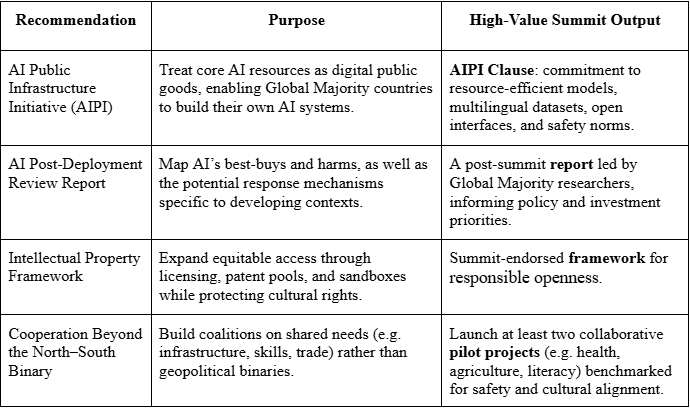
Table 1: A summary table of AI benefit-sharing mechanisms to be operationalised at the India AI Impact Summit.
Conclusion
The India AI Impact Summit can set the tone for governing safe AI adoption globally. By advancing AIPI, mapping contextual harms, enforcing intellectual property frameworks, and fostering coalitions beyond traditional divides, India can translate its sutras into concrete action – ensuring AI serves humanity, accelerates socio-economic progress, and strengthens collective resilience. More on AI benefit-sharing, that is, balancing widespread access with non-proliferation, and the specific actions that developing states can take, will be featured in our recent whitepaper.
*We extend special thanks to all the workshop participants for contributing to the whitepaper and this summary piece.